To legally evict a tenant in Maple Ridge, you need a valid reason under British Columbia's Residential Tenancy Act.
You also have to serve the correct, properly filled-out eviction notice. This isn't a process you can rush. Even small mistakes can get your notice thrown out, forcing you to start the whole frustrating cycle over again.
Getting the "Why" Right: Valid Reasons for Eviction in BC
Before you even think about drafting a notice, you have to be certain your reason for eviction is legally sound. BC’s landlord-tenant laws are very specific. You can't end a tenancy simply because of a personality clash or a minor annoyance. If you try to evict someone without a solid legal footing, you're setting yourself up for a dispute at the Residential Tenancy Branch (RTB), which is a surefire way to lose time and money.At its core, every legal eviction in BC falls into one of two buckets: evictions "For Cause" or evictions for "Landlord's Use of Property." Knowing which one applies to your situation is the absolute first step.Eviction for Cause
"For Cause" is exactly what it sounds like—you're ending the tenancy because the tenant did something wrong. This means they've seriously broken a rule in your tenancy agreement or violated the Residential Tenancy Act itself. These are issues that directly harm the property, you as the landlord, or the other people living in the building.Here are some of the most common grounds for a "For Cause" eviction:- Consistently Late Rent: We're not talking about a one-off slip-up. To qualify, you need to show a clear pattern of late payments, usually at least three times.
- Significant Property Damage: This is well beyond everyday wear and tear. Think large holes in walls, broken windows from carelessness, or unapproved "renovations" that compromise the unit's integrity.
- Illegal Activities: If your tenant—or someone they've allowed on the property—is involved in illegal acts that have damaged the property or threaten the safety of others, you have strong grounds to evict.
- Disturbing Neighbours: A tenant who consistently and unreasonably bothers other residents, you, or the neighbours can be evicted, especially if you've already given them written warnings to stop.
Landlord's Use of Property
- Personal Occupancy: You or a close family member plan to move into the rental unit. "Close family" is narrowly defined as a parent, spouse, or child of either the landlord or the landlord's spouse.
- Sale of Property: You've sold the property, and the new owner has given you a written request to end the tenancy because they (or their close family) intend to live there.
- Major Renovations: The planned renovations are so extensive that the unit absolutely must be empty to complete them safely and properly.
To help clarify the differences, here's a quick summary of the legal grounds for ending a tenancy in British Columbia.
Legal Grounds for Eviction in British Columbia
Eviction Type/Common Examples/Required Notice Period/For Cause- Repeatedly late rent- Serious property damage
- Illegal activity
- Disturbing the peaceOne Month Notice to End TenancyLandlord's Use- Landlord or close family moving in
- Unit sold, new owner moving in
- Major renovations, Two Month Notice to End Tenancy, Non-Payment of Rent- Tenant fails to pay full rent on the due date, 10 Day Notice to End Tenancy.
This table provides a high-level overview, but remember that each situation has its own nuances. Always refer to the specific notice form and the Residential Tenancy Act to ensure you're following the correct procedure and timeline.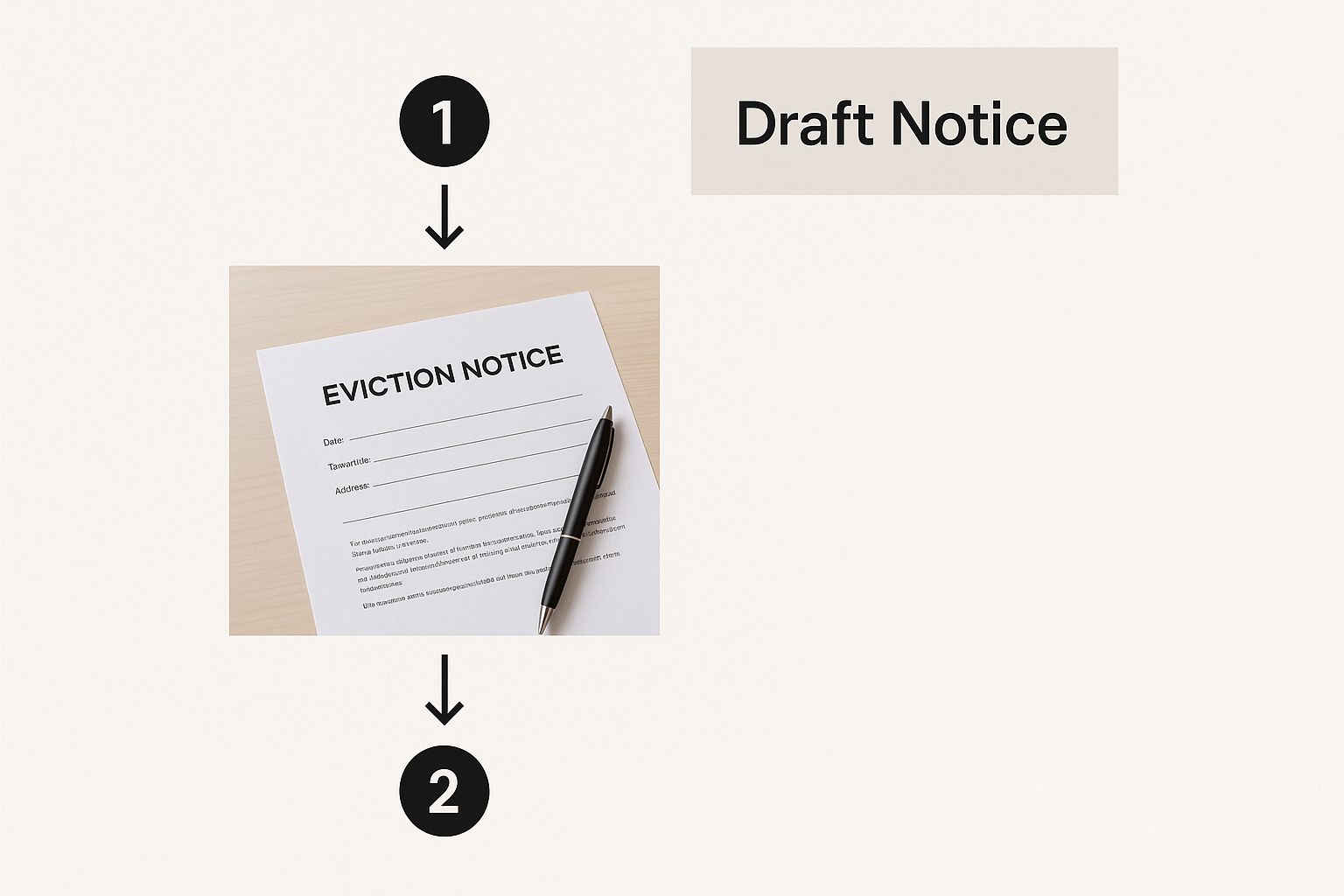 As you can see, drafting the correct notice is the first major action. Meticulous preparation here is where a successful eviction truly begins.
Preparing and Serving the Eviction Notice
So, you've established you have a legal, valid reason to evict. Now comes the most critical piece of paperwork in the entire process: the eviction notice itself. Think of this document as the foundation of your entire case. One small mistake—an incorrect date, a vague reason, or improper delivery—can get your notice thrown out, forcing you to start all over again. That's a delay you can't afford, especially when you're dealing with unpaid rent.In British Columbia, you can't just scribble a note telling your tenant to leave. You absolutely must use the official forms from the Residential Tenancy Branch (RTB). Each form is tailor-made for a specific reason, and using the wrong one is an immediate red flag for an RTB arbitrator.Let's walk through the essential notice forms you'll encounter as a landlord in Maple Ridge.Choosing the Correct Eviction Form
The form you need is dictated entirely by why you're ending the tenancy. Getting this right is your first real test.- 10 Day Notice to End Tenancy for Unpaid Rent or Utilities (RTB-30): This is your go-to for the most common eviction scenario. You can serve this the day after rent is officially late.
- One Month Notice to End Tenancy for Cause or for End of Employment (RTB-33): This form is for breaches of the tenancy agreement. Think significant property damage, illegal activity, or a pattern of consistently late rent payments.
- Two Month Notice to End Tenancy for Landlord's Use of Property (RTB-32): This is what you'll use when you or a close family member plan to move in, or if you've sold the property and the new owner wants it vacant.
- Four Month Notice to End Tenancy for Demolition or Conversion of a Rental Unit (RTB-29): Reserved for major changes, like demolishing the unit or converting it into something non-residential.
As you can see, drafting the correct notice is the first major action. Meticulous preparation here is where a successful eviction truly begins.How to Properly Serve the Notice
Once you've perfectly filled out the notice, you have to deliver it in a way the law recognizes. A quick text or email won't cut it. The Residential Tenancy Act is very clear about how a notice must be served to be considered legally delivered.Accepted methods of service include:- In-person delivery: Handing the notice directly to the tenant. If they aren't home, you can give it to an adult who appears to live with them.
- Posting on the door: Taping or attaching the notice securely to the main door of the rental unit or another obvious spot on the property.
- Mailbox or mail slot: Simply putting the notice in their mailbox or through the mail slot.
- Registered mail: Sending the notice using Canada Post Registered Mail. Always keep your receipt as proof of mailing; it's non-negotiable.
Proving Service Is Everything
If your tenant disputes the eviction, one of the first things an arbitrator will ask for is proof that you served the notice correctly. Your word alone, "I handed it to them," just isn't enough.The moment you serve the notice, you need to fill out a Proof of Service Notice to End Tenancy (RTB-34). The best practice? Have a witness with you who isn't a party to the tenancy. They will sign the form, verifying the date, time, and how you delivered it. This piece of paper becomes a cornerstone of your evidence if you end up in a hearing.I've seen it happen. A landlord lost a hearing because they went alone and didn't have a signed Proof of Service form. The tenant simply claimed they never got the notice. Without concrete proof, the arbitrator had no choice but to side with the tenant. That landlord had to start the entire process over, losing thousands in rent. It's an expensive way to learn the importance of paperwork. So, your tenant has decided to dispute the eviction notice. This is where things get serious, and your next stop is a hearing with the Residential Tenancy Branch (RTB). I know this part can feel intimidating, but honestly, being well-prepared is your best and only advantage. Your success here is what will ultimately get you an Order of Possession—the legal document you need to officially reclaim your property.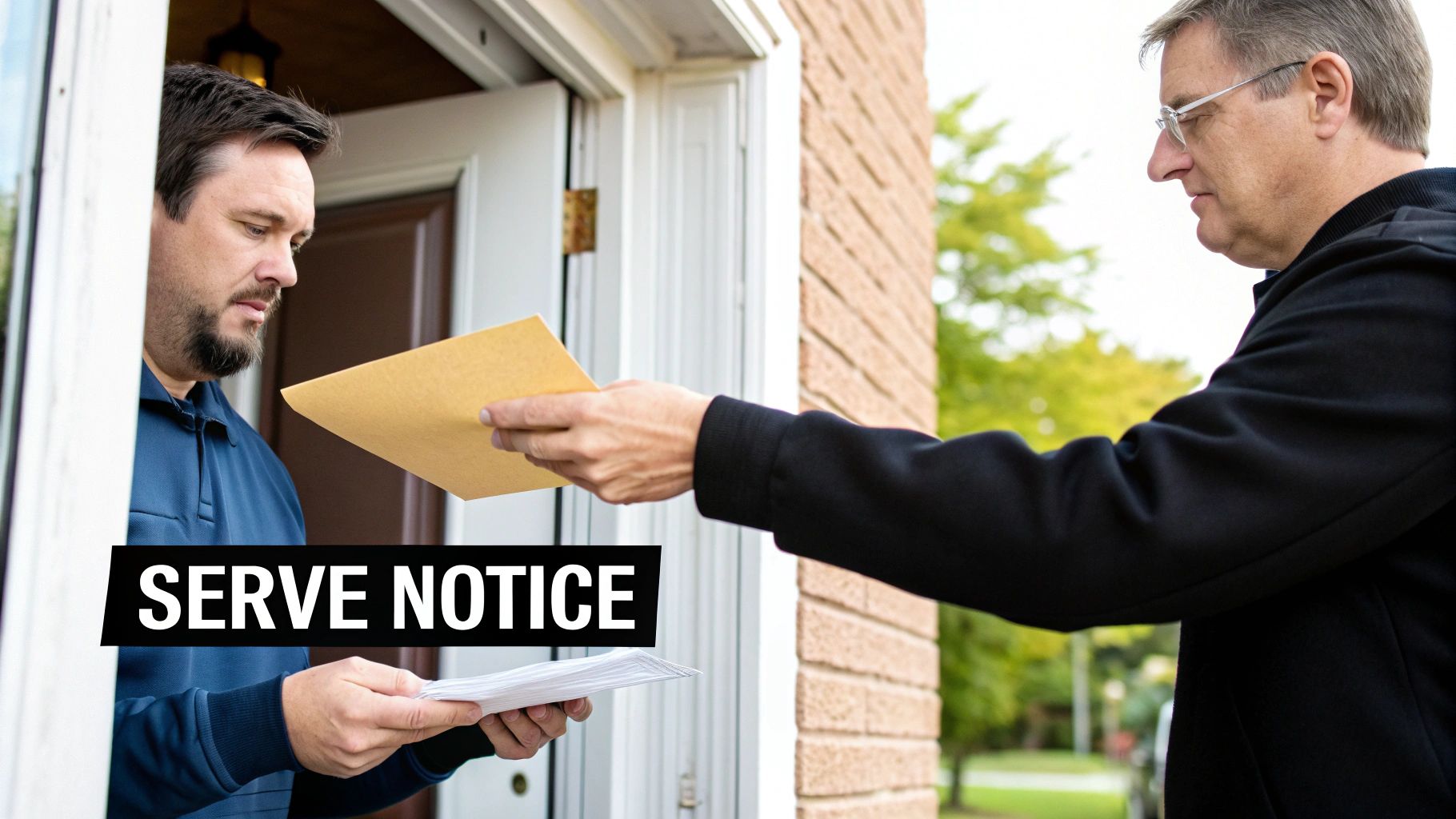 Once the tenant files their dispute, you'll get a package from them containing their application and all the evidence they plan to use. This is your cue. It's time to start putting together your own detailed response. The RTB process is formal, and the outcome will hinge entirely on your ability to present clear, factual evidence.
Applying for Your Own Hearing and Building a Rock-Solid Case
Even though the tenant started the dispute, you need to file your own application for dispute resolution to formally request that Order of Possession. This means filling out the right RTB form and paying the application fee. But more importantly, this is when you assemble a compelling, undeniable evidence package.Your evidence is everything. An arbitrator won’t just take your word for it; they need documented proof for every claim you make. Your package needs to be meticulously organized, easy for an arbitrator to follow, and directly tied to the reason for the eviction.Here’s what you absolutely must include in your evidence package:- The Tenancy Agreement: A complete and signed copy of the original lease.
- The Eviction Notice: The exact notice you served, with no alterations.
- Proof of Service: The signed Proof of Service (RTB-34) form. Having a witness signature here is a game-changer.
- Communication Log: A chronological record of all relevant emails, texts, and letters. This creates a clear timeline for the arbitrator.
- Rent Ledger: For non-payment evictions, this is non-negotiable. A clean ledger showing all payments, dates, and the current outstanding balance is crucial.
- Photos and Videos: For proving property damage, nothing beats date-stamped photos or videos.
What to Expect During the Teleconference Hearing
In British Columbia, most RTB hearings happen over the phone. You, the tenant, any witnesses, and an impartial RTB arbitrator will all dial into a conference call at a specific time. Think of the arbitrator as a judge—they guide the hearing and make the final, legally binding decision.The hearing itself is quite structured. The arbitrator will start by laying out the rules. Usually, the applicant (often the tenant who is disputing the notice) gets to present their side first. Then, it’s your turn.The key is to remain calm, professional, and focused on the facts. This is a business proceeding, not a personal argument. Stick to your evidence, reference your documents clearly (e.g., "On page five of my evidence package, you can see the email I sent on May 15th"), and resist the urge to get pulled into emotional or irrelevant debates.It's a common misconception that landlords always have the advantage. The truth is, arbitrators are bound by the law, and a well-prepared tenant can easily win if the landlord's case is sloppy. Success hinges on meticulous preparation and following the rules to the letter.Making Your Case and Concluding the Hearing
After you’ve presented your side, the tenant gets a chance to respond and ask you questions. The arbitrator might also jump in with clarifying questions for both of you. Your job is to answer directly and honestly, always bringing it back to the proof in your evidence package.A few tips from experience for a successful hearing:- Be Hyper-Organized: Have your evidence package in front of you, with key pages tabbed or marked so you can find them instantly.
- Stay on Topic: If the tenant brings up issues that have nothing to do with the eviction, politely steer the conversation back to the legal reason for the notice. Don't get sidetracked.
- Speak Clearly and Concisely: The arbitrator is listening for facts that prove your claim. Present your points logically and get straight to the point.
Enforcing Your Order of Possession
Holding a signed Order of Possession from the Residential Tenancy Branch (RTB) feels like crossing the finish line, but it’s really the final, critical lap. While most tenants will respect this legally binding order and move out, some just won't budge.If your tenant digs in their heels and defies the order, you absolutely cannot change the locks or haul their stuff to the curb. Taking matters into your own hands is illegal and will land you in a world of legal and financial trouble.The next steps are formal, precise, and must be followed to the letter. This is where you move out of the RTB's jurisdiction and into the enforcement power of the BC Supreme Court.Serving the Order of Possession
Your first task is to formally serve the tenant with the Order of Possession. Just like when you served the original eviction notice, how you do it matters. You need undeniable proof that the tenant received the order and knows the date they're required to leave.Proven methods for serving this document include:- Handing it directly to the tenant.
- Giving it to another adult who also lives in the unit.
- Posting it prominently on their front door.
When the Tenant Still Won't Leave
So, the effective date on your Order of Possession has come and gone, and your tenant is still there. Now it's time to escalate. The RTB’s job is done once they issue the order; they don’t have enforcement officers to remove people. That responsibility falls squarely on you.Your next move is to take that RTB Order of Possession to a BC Supreme Court registry. There, you'll have it converted into a Writ of Possession. This is the document that carries real teeth—it's a court order directing an authorized bailiff to remove the tenant and their belongings from your property.This isn’t an optional step. It is the only legal path in British Columbia to have a tenant physically removed. The process involves specific forms and court fees, and because of the legal details, many landlords find it worthwhile to have a lawyer or paralegal handle the filing to ensure it's done right the first time.Hiring a Court-Approved Bailiff
With a Writ of Possession in hand, you can now engage a civil enforcement agency, more commonly known as a court bailiff. You can't just hire any security company; you must use a court-approved bailiff authorized to enforce Supreme Court orders in BC.The bailiff takes charge from here. They'll coordinate the final, decisive steps of the eviction.Here’s a snapshot of what that looks like:- Scheduling the Removal: The bailiff schedules a date and time to attend the property. Often, they’ll give the tenant a final "Notice to Vacate," offering one last chance to leave without being physically removed.
- Executing the Writ: If the tenant is still present on the scheduled day, the bailiff will arrive to carry out the eviction. You should arrange for a locksmith to be there to change the locks the moment the property is vacant, securing it immediately.
- Managing Belongings: The bailiff oversees the handling of the tenant's personal property in accordance with provincial laws.
Documentation Practices to Protect Your Investment
When you’re a landlord, especially when facing the tough process of an eviction, your best friend is a rock-solid paper trail. Let me be frank: when a dispute ends up before the Residential Tenancy Branch (RTB), the landlord with organized, detailed records almost always comes out on top. This isn't just about good habits; it's the bedrock that protects your entire investment.This isn't about creating busywork for yourself. It’s about building an unshakeable case that proves you've acted fairly, legally, and professionally every step of the way. From the moment a tenant gets the keys until the day they move out, every significant interaction and transaction needs to be on record.
Building Your Evidence File from Day One
The time to start documenting is long before you even think there might be a problem. A complete, organized file for every single tenancy is your go-to resource, providing a clear, chronological history that an arbitrator can easily understand.Think of it as your tenancy binder. At a bare minimum, it must contain:- The Original Tenancy Agreement: This is your core contract. Make sure it’s filled out completely, signed by everyone involved, and includes any extra terms or addendums you agreed to.
- Move-In and Move-Out Condition Reports: These are mandatory in BC for a reason. They are your single best piece of evidence for proving any damage that goes beyond normal wear and tear. You need to complete these with the tenant, be thorough, take plenty of photos, and get both parties to sign.
- Proof of Rent Payments: A detailed rent ledger is non-negotiable. It should clearly track when rent was due, the date you actually received it, the amount paid, and any running balance. No exceptions.
The Power of a Detailed Communication Log
Once a tenancy starts to feel a bit rocky, your communication log becomes your most valuable asset. This is much more than a messy folder of old emails; it’s a detailed, chronological record of every important conversation you've had.Let's say you're dealing with ongoing noise complaints. Your log should tell the whole story. Note the date of the first complaint from a neighbour, the date you sent a formal written warning to your tenant, and what their response was (or if they didn't respond at all). This simple record proves you gave the tenant a fair opportunity to fix the problem before resorting to an eviction notice. A well-kept log can instantly shut down a "he said, she said" argument by turning it into a timeline of facts. It showcases your professionalism and diligence, which carries immense weight in an RTB hearing. Without it, you’re just relying on memory, and I can tell you from experience, that’s never enough. With economic pressures mounting on renters, disputes are becoming more common. For instance, a recent study in San Mateo County, California showed a 35% jump in eviction filings in 2023 over pre-pandemic numbers, mostly due to unpaid rent. While this is a different jurisdiction, the trend highlights why landlords everywhere must keep flawless records around payments and communications—these are the issues that come under the most scrutiny. You can discover more insights about this study on eviction trends and what it means for landlords.Using Photographic and Video Evidence
In any situation involving property damage, unauthorized changes, or even a tenant claiming you haven't done repairs, a picture is worth a thousand words. Better yet, date-stamped photos and videos provide objective proof that is incredibly difficult to argue with.Picture this: a tenant moves out and you find a huge hole in the drywall. They claim it was there when they moved in. But what if you could pull up a date-stamped photo from your move-in inspection showing a pristine wall? Case closed. Always take more photos than you think you’ll ever need during inspections and before and after completing any repairs. Organize them into clearly labelled digital folders for each property. This kind of visual evidence can instantly validate your claims and stop a false argument in its tracks.Common Questions About BC Evictions
Navigating the eviction process in British Columbia always seems to throw a few curveballs. Even when you think you have a solid plan, a tricky "what if" scenario can pop up, leaving you wondering what to do next. Let's tackle some of the most frequent questions I hear from landlords here in Maple Ridge to give you the clarity you need.What Happens if a Tenant Abandons the Property?
It happens more often than you'd think. A tenant gets behind on rent, you serve them an eviction notice, and then... they just vanish, leaving a unit full of their stuff behind. When you have good reason to believe they've truly abandoned the property, you can legally take it back, But "reasonable grounds" is a high bar—it’s more than just a gut feeling. You need solid evidence. Typically, this means the rent is unpaid and you have proof they aren't coming back. Maybe neighbours saw them packing up and leaving, or the utilities have been shut off in their name. Your first move should be to document everything meticulously. Take pictures of the unit's state, make detailed notes with dates, and keep copies of every text, email, or letter. Once you've built that case, you can change the locks and secure your property.Handling a Tenant’s Abandoned Belongings
Now, for the belongings left behind. Just because a tenant has bolted doesn't give you a free pass to haul everything to the dump. The Residential Tenancy Act has very specific, strict rules for handling abandoned personal property. They're designed to give the tenant a fair opportunity to get their things back.What you're legally required to do hinges on the estimated value of the items:- Low Value (Under $500): If you figure the total worth of their stuff is less than $500, you need to store it all in a safe place for at least 30 days. You also have to make a reasonable effort to contact the tenant and tell them where their property is.
- Higher Value (Over $500): When the items are clearly worth more than $500, the rules get even tighter. You must store everything for a full 60 days. If the tenant is a no-show after that period, you can sell the items at a public auction. The money you make can cover your costs for moving, storing, and selling the goods, plus any rent or damages they owe you. Any money left over must be sent to the administrator of the Unclaimed Property Act.
Can You Evict a Tenant During the Winter?
This is easily one of the most stubborn myths in BC tenancy law. Let me be perfectly clear: yes, you absolutely can evict a tenant during the winter. There is no law in British Columbia that puts a freeze on evictions just because it's cold outside. The legal process is exactly the same, no matter the season. As long as you have valid grounds—unpaid rent, for-cause issues, or landlord's use of property—you follow the standard procedure. Serve the right notice, stick to the timeline, and if needed, file with the RTB. An arbitrator isn't going to throw out a legitimate case because it's December. When you look at the data, the reason for most evictions is clear. For example, in a major market like Los Angeles, a staggering 94% of eviction notices filed between early 2023 and mid-2025 were for non-payment of rent. This just goes to show that while myths about winter evictions linger, the real driver is almost always financial. That's why it's so important to follow the correct legal steps for non-payment, no matter the time of year. You can learn more about eviction filing statistics and their causes to see these trends for yourself.Managing a rental property demands constant diligence, and that's never truer than when facing an eviction. If you want to protect your investment and ensure every step is handled professionally and legally, the team at Royal LePage Brookside Realty can help. From tenant screening to navigating the RTB, our property management experts take the stress off your shoulders. Learn more about our services and secure your peace of mind.